Morocco Language: What Languages Are Spoken in Morocco?
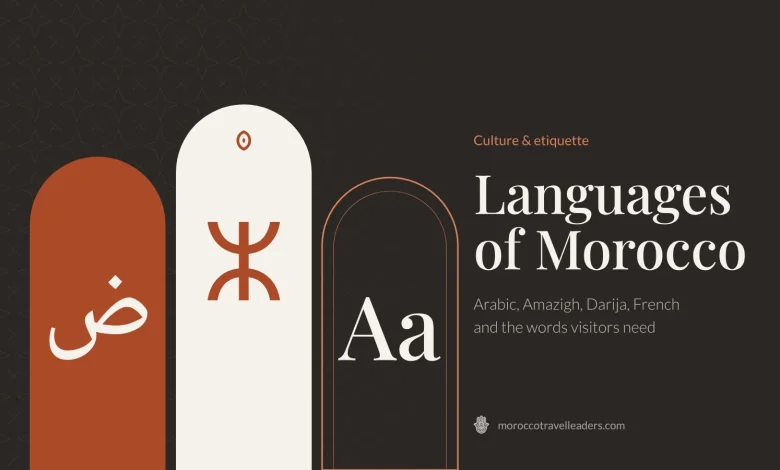
Morocco has two official languages, Arabic and Amazigh, both recognised by the Constitution of 2011. In daily life, nine Moroccans in ten speak Darija, the Moroccan form of Arabic, while French remains widely used in business, banking and higher education, and English is spreading quickly among younger people.
This guide explains which language is spoken where, what the official figures from the 2024 census show, and which words will help you most as a visitor, from the medina of Marrakech to the villages of the Atlas and the cities of the Sahara.
- Official languages: Arabic and Amazigh (Tamazight).
- Most spoken: Darija, used by 91.9% of the population.
- Amazigh used by 24.8% of Moroccans, in three main regional varieties.
- Hassaniya Arabic, protected by the Constitution, spoken in the Southern Provinces.
- French read and written by 57.7% of literate Moroccans, English by 20.5%.
Morocco is a multilingual country by history and by law. Its language policy rests on Article 5 of the Constitution adopted in 2011, which gives official status to two languages and protects the other expressions of Moroccan identity.
Arabic remains the official language of the State. Amazigh is also an official language of the State, as a common heritage of all Moroccans without exception. The State works to preserve Hassaniya as an integral part of the unified Moroccan cultural identity, and encourages the learning of the most widely used foreign languages.
The same article created the National Council for Moroccan Languages and Culture, responsible for protecting and developing Arabic, Amazigh and the country’s other cultural expressions.
The General Census of Population and Housing carried out in 2024 by the High Commission for Planning (HCP) gives a precise picture of what Moroccans actually speak.
The everyday language of the street, the market, the family and most television series.
Tachelhit 14.2%, Tamazight 7.4% and Tarifit 3.2%. Amazigh is used by 33.3% of the rural population and 19.9% of city dwellers.
Concentrated in the Southern Provinces of the Kingdom.
Two forms of Arabic coexist in Morocco. Modern Standard Arabic is the language of the State, the law, schooling, the press, official speeches and religious life. Among literate Moroccans aged ten and over, 99.2% can read and write Arabic, according to the 2024 census.
Darija is the spoken Moroccan Arabic used at home and in the street. It draws on Arabic and Amazigh, with vocabulary taken from French and Spanish, and has its own pronunciation and rhythm. Speakers of Arabic from the Middle East sometimes find it hard to follow at first, while Moroccans usually understand other forms of Arabic well through media and schooling.
Amazigh is the oldest language of North Africa. It became an official language with the Constitution of 2011, and Organic Law n° 26.16, published in the Bulletin Officiel in September 2019, sets out how that status is applied in education, legislation, the media, culture and public services. The law adopts Tifinagh as the script for writing Amazigh.
Three main regional varieties are spoken in the Kingdom:
The most widely used variety, heard around Agadir, Taroudant, Tiznit and in the valleys south of Marrakech.
Spoken around Khenifra, Azrou and Midelt, and across the oases and valleys of the Draa and Tafilalet.
The language of the north-east, around Al Hoceima and Nador.
According to the 2024 census, Amazigh is the mother tongue of 64% of the population in the Draa-Tafilalet region and 56.4% in Souss-Massa. The Royal Institute of Amazigh Culture (IRCAM), founded in 2001, works on the standardisation and teaching of the language. Since 2023, the Amazigh New Year, Id Yennayer, celebrated on 14 January, has been an official paid public holiday.
Hassaniya is the form of Arabic spoken in the Moroccan Sahara, in the regions of Laayoune-Sakia El Hamra, Dakhla-Oued Ed-Dahab and Guelmim-Oued Noun. It carries a rich oral tradition of poetry and storytelling, and the Constitution commits the State to preserving it as part of the unified Moroccan cultural identity. Darija and Standard Arabic are understood throughout these regions.
French has no official status, but it holds a strong place in economic life. It is used in banking, business, medicine, engineering and many university courses, and appears on road signs, menus, shop fronts and administrative forms. The 2024 census found that 57.7% of literate Moroccans aged ten and over can read and write French.
For a visitor, French is the most useful foreign language in Morocco. Taxi drivers, shopkeepers, hotel staff and guides in the cities generally speak it with ease.
Spanish is understood in parts of the north, around Tetouan, Tangier and Larache, and among older generations in the south, a legacy of history and proximity to Spain. Only 1.2% of literate Moroccans report reading and writing it.
English is the fastest-growing foreign language. The 2024 census counts 20.5% of literate Moroccans who read and write it, and the Ministry of National Education has been extending English teaching to all middle schools since 2023. In hotels, riads, restaurants and tourist sites of the large cities, English is widely spoken.
You can travel across Morocco speaking English or French. A few words of Darija, or of Amazigh in the mountains, are always welcomed and often open a warmer conversation.
- In Marrakech, Fes, Casablanca, Rabat and Tangier: English and French in hotels and shops, Darija everywhere else.
- In the High Atlas and the Souss: Tachelhit in the villages, with Darija and some French.
- In the Middle Atlas, the Draa valley and around Merzouga: Tamazight and Darija.
- In Laayoune and Dakhla: Hassaniya and Darija, with Spanish heard among older residents.
Transliterations follow the most common spelling used by Moroccans when writing Darija in Latin letters.
Darija
Hello, peace be upon you. The reply is “wa alaykum salam”.
Thank you. “Shukran bezzaf” means thank you very much.
Please, used for any request.
No, thank you. Polite and firm in the souks.
How much is it?
Excuse me, sorry.
OK, agreed.
Goodbye.
Amazigh
Hello, used across the Amazigh-speaking regions.
Thank you.
Public buildings display their names in Arabic and in Amazigh written in Tifinagh, the script with geometric letters such as ⵣ, the symbol often seen on flags and jewellery. Road signs, stations and airports usually add French. In practice, a visitor who reads the Latin alphabet can find their way without difficulty.
What is the official language of Morocco?
Morocco has two official languages, Arabic and Amazigh, under Article 5 of the 2011 Constitution.
Do people speak French in Morocco?
Yes, widely. French has no official status but is used in business, banking and higher education, and 57.7% of literate Moroccans read and write it.
Is English spoken in Morocco?
Increasingly. It is common in hotels and tourist areas, and 20.5% of literate Moroccans read and write it according to the 2024 census.
What is Darija?
The spoken Moroccan Arabic used by 91.9% of the population, with words drawn from Amazigh, French and Spanish.
What language is spoken in Marrakech?
Darija above all, with Tachelhit spoken by many families from the surrounding mountains. French and English are widely used with visitors.
How do you say thank you in Morocco?
“Shukran” in Darija, and “tanmirt” in Amazigh.
- Constitution of the Kingdom of Morocco, 2011, Article 5Official languages
- Organic Law n° 26.16 on the official character of Amazigh, 2019Amazigh in public life
- High Commission for Planning (HCP), General Census of Population and Housing 2024Language statistics
- Royal Institute of Amazigh Culture (IRCAM)Amazigh language and Tifinagh
Related guides: Morocco currency · Alcohol in Morocco · Drone laws in Morocco
Census figures are those published by the High Commission for Planning in December 2024. Last reviewed October 2026.