Morocco currency: The Moroccan dirham explained for bisitors
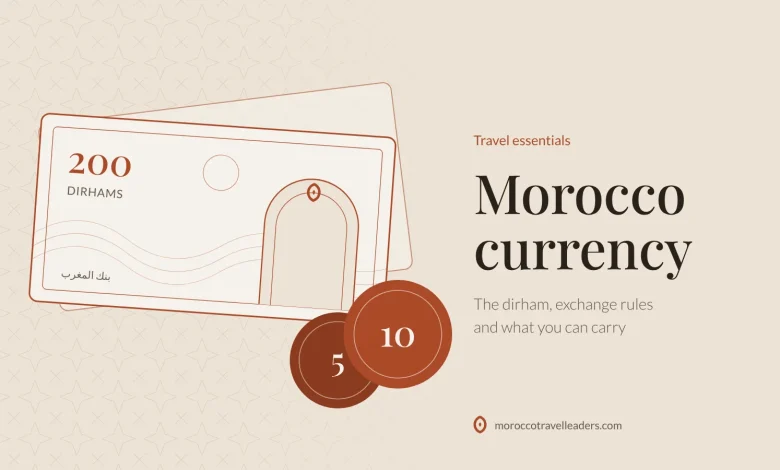
The currency of Morocco is the Moroccan dirham, code MAD, issued by Bank Al-Maghrib, the central bank. It is a closed currency: you can take only a small amount of dirhams in or out of the country, so most visitors arrive with euros, pounds or dollars, or a bank card, and obtain their dirhams once in Morocco.
This guide covers the notes and coins you will handle, where to exchange money legally, the declaration rules for foreign currency, and how to change leftover dirhams back before you fly home.
- Currency: Moroccan dirham (MAD), divided into 100 centimes. Written DH locally, د.م. in Arabic.
- Banknotes: 20, 50, 100 and 200 dirhams. Coins from 10 centimes to 10 dirhams.
- Dirhams you may carry in or out of Morocco: 2,000 MAD per traveller.
- Foreign currency worth 100,000 MAD or more must be declared to customs.
- Keep every exchange receipt: you need it to change dirhams back.
Morocco’s currency is the dirham, and its international code is MAD. One dirham is divided into 100 centimes. Prices are written with “DH” or “Dhs” after the amount, as in 50 DH, and with the abbreviation د.م. in Arabic. Banknotes and coins are issued by Bank Al-Maghrib and produced by Dar As-Sikkah, its printing works, in Rabat.
The dirham is the only legal tender in the Kingdom, from Tangier to Lagouira. Some hotels quote rates in euros for convenience, but everyday purchases, taxis, markets and restaurants are paid in dirhams.
In markets you may hear prices in rials, an old unit still used in daily speech: 20 rials make one dirham. If a figure sounds too high, ask whether it is in dirhams.
Between November 2023 and August 2024, Bank Al-Maghrib put a new series of notes and coins into circulation, designed and produced entirely in Morocco. Each note carries the portrait of His Majesty King Mohammed VI and the national coat of arms on the front. Older notes are still seen alongside the new series.
Architectural heritage and social development: the Al Qaraouiyine University in Fes on the front, the Grand Théâtre de Rabat and the Kasbah of Aït Ben Haddou on the back.
Sustainable development: the Ouzoud waterfalls on the front, the Noor solar complex in Ouarzazate, wind turbines and the Agadir desalination plant on the back.
The cultural heritage of the Moroccan Sahara: the Hassan II Mosque on the front, the Mechouar square in Laayoune, the Tiznit to Dakhla expressway and the Moussem of Tan-Tan on the back.
Infrastructure and industry: the Mohammed VI cable-stayed bridge on the front, the Mohammed VI Tower and Marrakech-Menara airport on the back.
Coins come in 10 and 20 centimes, half a dirham, and 1, 2, 5 and 10 dirhams. The new coin series is themed on agriculture, the environment, cultural diversity, national sovereignty, the development of the Moroccan Sahara and infrastructure. Small coins are useful for parking attendants, public toilets and small purchases.
The dirham is not freely convertible. Exchange operations are governed by the Office des Changes, whose General Instruction on Foreign Exchange Operations sets what travellers may carry and how money may be exchanged. In practice, this has two consequences for visitors.
Travellers may import and export Moroccan banknotes up to 2,000 dirhams per trip. Beyond that amount, dirhams cannot leave or enter the country in cash.
- You will rarely find dirhams at exchange offices abroad, and buying more than 2,000 MAD before travel would serve no purpose.
- Dirhams left over at the end of the trip should be spent or changed back in Morocco, since they are hard to exchange outside the country.
Non-resident visitors may bring in foreign currency without any limit on the amount. A written declaration is required at the border when banknotes and bearer instruments reach the equivalent of 100,000 dirhams or more, on arrival as on departure. The UK Foreign Office gives the same threshold in its advice for Morocco.
- Declare the amount to customs on arrival, at the port or airport of entry.
- The declaration is valid for one stay only, and for no more than six months.
- Keep it: customs will ask for it if you leave with foreign currency of 100,000 MAD or more.
- Undeclared amounts above the threshold can be seized, and a fine applies.
You may also declare smaller amounts. This can help if you need to justify the origin of foreign currency when you leave.
Foreign currency must be exchanged through authorised channels. Euros, US dollars and pounds sterling are accepted by every exchange counter, and most also take other major currencies.
Exchange at the counter on presentation of your passport, during banking hours.
Found in city centres, medinas, train stations and airports, with longer opening hours. The approval and the rates of the day must be displayed.
Many larger hotels exchange currency at reception, usually at a less favourable rate.
Each exchange gives you a receipt, the bordereau de change. Keep it for the whole stay. Never change money with individuals in the street: the practice is illegal, the rate is rarely better, and counterfeit notes circulate this way.
The dirham is pegged to a basket of two currencies, 60% euro and 40% US dollar, and may move within a band of plus or minus 5% around a central rate. As a result, its value against the euro and the dollar stays relatively stable, while it follows the pound sterling through the euro.
Bank Al-Maghrib publishes reference rates every business day. Exchange offices set their own buying and selling rates around them, so compare two or three displays before changing a large amount. Check the rate on the day rather than relying on a figure found in advance.
Visa and Mastercard are accepted in hotels, larger restaurants, shopping centres and many shops in the cities. Cash remains necessary in the souks, small cafés, taxis, villages and much of the countryside. Cash machines are common in towns and dispense dirhams directly.
- Tell your bank before travelling, so that payments in Morocco are not blocked.
- When a terminal offers to charge you in your home currency, choose dirhams: the conversion offered on the spot is usually more expensive.
- Ask your bank about fees for withdrawals and card payments abroad.
- Use cash machines attached to a bank branch, preferably during opening hours.
Authorised exchange offices may buy back the dirhams you have left at the end of your stay. The operation is made on presentation of the exchange receipt from your initial purchase, and a new receipt is issued for the currency you receive.
- Keep every bordereau de change from the day you arrive.
- Change back your remaining dirhams at the airport or port exchange offices before departure.
- Within the 2,000 MAD limit, you may keep a small amount for a future trip.
The new series includes several security features described by Bank Al-Maghrib. A few seconds are enough to check a note, especially a 100 or 200 dirham note.
- A security thread that changes colour when the note is tilted.
- An iridescent band on the back.
- Raised printing you can feel with the finger, designed to help visually impaired people.
- Serial numbers printed in increasing size.
What is the currency of Morocco?
The Moroccan dirham, code MAD, divided into 100 centimes and issued by Bank Al-Maghrib.
What is the Moroccan currency symbol?
Prices are written DH or Dhs, as in 100 DH, and د.م. in Arabic. The international code is MAD.
Can I get Moroccan dirhams before I travel?
Rarely, because the dirham is a closed currency, and you may only bring in 2,000 MAD. Most travellers exchange money or withdraw cash on arrival.
Can I pay in euros or dollars in Morocco?
Some hotels quote prices in euros, but the dirham is the legal tender and everyday purchases are paid in dirhams.
How much cash can I bring into Morocco?
There is no limit on foreign currency, but amounts of 100,000 MAD or more must be declared to customs. Dirham banknotes are limited to 2,000 MAD.
Can I take dirhams out of Morocco?
Up to 2,000 MAD per traveller. Change the rest back at an authorised exchange office before departure, with your exchange receipt.
Is it better to use a card or cash in Marrakech?
Both. Cards work in hotels and larger shops, while the medina, taxis and small restaurants generally expect cash in dirhams.
- Bank Al-MaghribBanknotes, coins, reference rates
- Office des Changes, General Instruction on Foreign Exchange OperationsExchange and travellers
- Administration des Douanes et Impôts Indirects (ADII)Currency declaration
- UK Foreign, Commonwealth & Development OfficeMorocco entry requirements
Related guides: Alcohol in Morocco · Drone laws in Morocco
This article is general information for visitors, not financial or legal advice. Exchange rules and limits are set by the Moroccan authorities and can change. Confirm current requirements with Bank Al-Maghrib, the Office des Changes or Moroccan customs before travelling. Last reviewed October 2026.