Ultimate Marrakech to Merzouga Tour Guide
Marrakech to Merzouga Tour: The Complete Guide for 2026
Everything you need to plan a Marrakech to Merzouga tour, from transport and route stops to camel trekking, desert camps, and the best time to visit the Erg Chebbi dunes.

A Marrakech to Merzouga tour is far more than a transfer between two points on the map. The road unfolds gradually, from terracotta rooftops and orange blossom lanes, across the switchbacks of the High Atlas, through ancient kasbah villages, and finally into the vast amber sea of Erg Chebbi. Few journeys anywhere in the world pack so many landscapes, cultures, and textures into a single route.
This guide walks you through every practical detail of the Sahara desert trip from Marrakech: transport options with current fares and schedules, the stops that genuinely deserve your time, where to sleep among the dunes, and what to do once you arrive in Merzouga. Whether you have one day or four, a tight budget or a taste for luxury, you will find what you need here.
Why the Marrakech to Merzouga Route Stands Apart
↑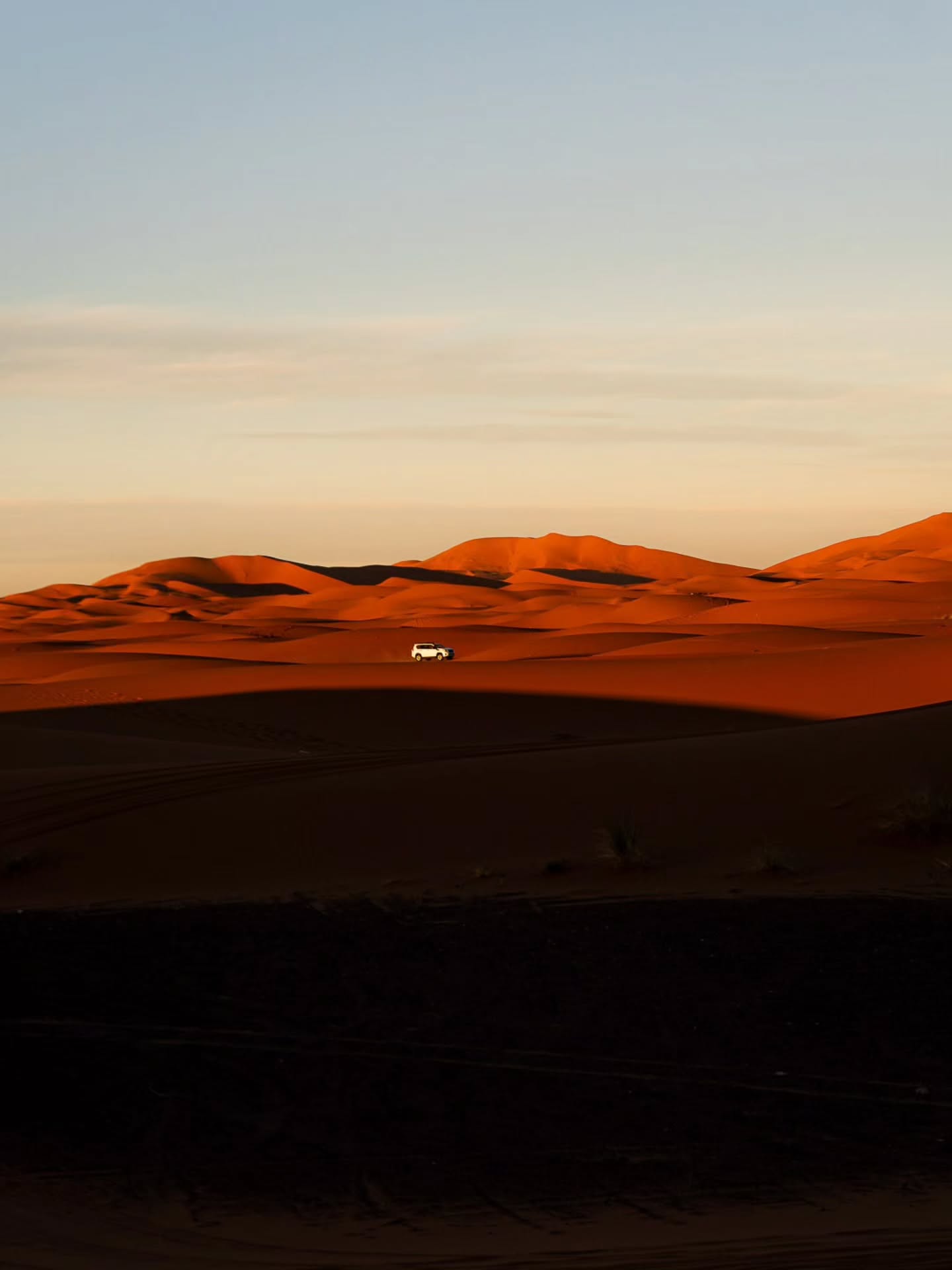
Morocco has no shortage of memorable road trips, but this one holds a singular place in the country’s travel canon. The appeal begins with sheer geographical variety. In a single day of driving you climb from subtropical gardens at 450 metres to an alpine pass at 2,260 metres, then descend through pre-Saharan palm groves until the dunes finally rise on the horizon. Each altitude band brings its own colour palette, its own smells, its own people.
Then there is the cultural layering. The route crosses Amazigh (Berber) heartland, follows the Draa and Dadès valleys where oasis agriculture has sustained nomadic and semi-nomadic communities for millennia, and reaches the Filali southeast, whose music, cuisine, and architecture diverge meaningfully from the Marrakech you left behind. Arriving in Merzouga does not feel like reaching the same Morocco. It feels like discovering a second country inside the first.
Finally, there are the dunes themselves. Erg Chebbi rises to roughly 150 metres at its tallest ridgelines. Standing at the crest at dusk, watching the light drain from orange to rose to violet across 30 kilometres of unbroken sand, is one of those experiences that resists description and justifies the whole journey on its own.
Best Time to Visit Merzouga: Seasons Honestly Compared
↑Every month in the desert has its character. Here is a frank comparison rather than a promotional summary:
Spring (Mar – May)
Ideal temperatures (18–28 °C), wildflowers in the Atlas, and the annual Rose Festival in Kelaat M’Gouna each May. The most balanced season for a Marrakech to Merzouga desert tour. The dunes can be a little windy in March.
Summer (Jun – Aug)
Daytime heat reaches 42–46 °C in the desert, compensated by warm nights (15–22 °C) that are ideal for camping, remarkably clear skies for stargazing, and the best conditions for traditional sand therapy. Noticeably fewer crowds than spring.
Autumn (Sep – Nov)
The second sweet spot. Heat retreats, date palm harvests fill the kasbahs with activity, and the dunes recover the golden warmth they lose under summer glare. October is especially rewarding for photographers.
Winter (Dec – Feb)
Cold nights (near 0 °C in the desert, occasional snow on Tizi n’Tichka). Dramatic light and empty landscapes. You may need an extra blanket in camp, but the Atlas crossing can be genuinely magical under snow. Brief mountain road closures are a rare risk in January.


How to Get from Marrakech to Merzouga: Transport Options
↑Three main ways exist to cover the Marrakech to Merzouga distance. Each suits a different kind of traveller, and none is objectively superior.
| Option | Journey time | Cost (MAD) | Schedule | Best for |
|---|---|---|---|---|
| Flight + transfer | 2–3 hrs total | 185 – 400 | 3× per week | Limited-time travellers |
| Overnight bus | ~12 hrs | ~220 | Daily 14:35 → 06:15 | Budget and local flavour |
| Private / guided tour | 9 hrs driving | Varies by package | Fully flexible | Cultural immersion |
By Air: Marrakech (RAK) to Errachidia (ERH)
Ryanair operates the only scheduled service on this corridor, three times per week. The flight itself lasts one hour and passes directly over the Atlas, a free aerial preview of the landscape you would otherwise cross by road. Book at least a week ahead to reach the lower fare band.
From Errachidia airport, three onward connections take you to Merzouga:
By Bus: The Supratours Overnight Service

The ONCF Supratours overnight coach is one of Morocco’s best-kept travel secrets. You board at Marrakech’s Gare Routière at 14:35 and wake up in the desert at 06:15, in time to watch sunrise paint the dunes without having paid for a night’s accommodation. The seats recline, the air conditioning works, and the route feels genuinely different at night: the Atlas passes become a succession of lit villages strung across dark mountain flanks, while the pre-Saharan valleys appear and vanish like a slow dream.
Supratours also runs a Marrakech to Rissani service as an alternative, stopping at several key towns along the Draa Valley corridor. For anyone who wants to break the journey midway, this line offers more flexibility.
Ticket price: approximately 220 MAD. Book in advance at any Supratours counter or through a local agency, particularly during the spring and autumn peak seasons.
By Private Tour: The Cultural Case
A professionally guided Marrakech to Merzouga tour is not simply a more comfortable version of the bus. It is a fundamentally different journey. A good guide does not just drive; they open doors. Into a kasbah courtyard that appears on no public map, into a conversation with a cooperative weaver, into a fossil market where they know which vendor’s pieces are genuine. The stops become encounters rather than photo opportunities.
The Route: Stops Worth Your Time
↑
Tizi n’Tichka Pass · 2,260 m
The highest road pass in Morocco. The paved route is safe year-round except during rare winter snowstorms. Stop at the roadside argan cooperatives and the granite-and-schist villages; the landscape changes visibly with every hundred metres of altitude.
Aït Benhaddou · UNESCO
The most photographed earthen architecture in the world, and with good reason. Visit early in the morning before the day-tour coaches arrive. Cross the seasonal river on foot to reach the ksar itself; the views from the granary at the summit repay every step.
Ouarzazate · Film Capital
Known as the Hollywood of Africa, Ouarzazate hosts Atlas Studios and Kasbah Taourirt. The Cinema Museum, opened in 2007, documents the major international productions shot here. Allow at least two hours to do the town justice.
Kelaat M’Gouna · Valley of Roses
Damask roses cultivated here produce rosewater exported worldwide. May brings the Rose Festival with music, processions, and harvest rituals. Even outside festival season, the valley’s cooperatives sell genuine rose products at fair prices.
Todgha Gorges · Tinghir
The canyon walls climb to 300 metres and narrow to barely 10 metres at the tightest point. A clear stream runs through the base all year. The gorge also draws technical rock climbers, with dozens of established routes.
Rissani · The Alaouite Cradle
Morocco’s ruling dynasty traces its roots to Rissani. The weekly souk (Tuesday, Thursday, Sunday) remains entirely local in character, with no tourist stalls. Try mdfouna, the buried-oven Berber flatbread, at one of the small restaurants near the market.
Suggested Itineraries: 2, 3 and 4 Days
↑Most travellers book a 3 day desert tour from Marrakech, and for good reason: it balances driving time with actual desert time. Here is how the main formats compare in practice.
Things to Do in Merzouga and the Erg Chebbi Dunes
↑
Camel Trekking at Sunset and Dawn
The classic approach is a one-hour sunset ride that delivers you to a desert camp as the light fades. A less common but more spectacular alternative is a dawn ride that reaches the highest accessible dune crest at first light. Ask your accommodation to arrange the latter rather than the standard sunset circuit.
Quad and 4×4 Exploration
Beyond the photogenic dune face that most visitors see, Erg Chebbi extends into a plateau of stone desert and ancient lake bed. Quad bikes and 4×4 excursions led by local guides reach fossil beds, isolated nomadic encampments, and the seasonal lake that forms in wet winters, drawing flamingos and rare migratory birds. These circuits run from 1.5 to 5 hours.
Stargazing in the Sahara
Light pollution is essentially absent around Merzouga. On a moonless night the Milky Way is bright enough to cast faint shadows. Several camps now offer guided astronomy evenings with telescopes; even without equipment, simply lying back on the dune surface for an hour is an experience most urban dwellers have genuinely never had.
Sablotherapy: Traditional Sand Wellness
Desert communities along Morocco’s southeast have practised partial sand burial as a therapeutic tradition for generations. The practice, known as sablotherapy, involves being buried to the neck in heated sand for 15 to 20 minutes, traditionally to ease joint inflammation and improve circulation. It is best experienced under the supervision of a local practitioner who understands both the conditions and the safety limits.
Food, Culture and the Filali Table
↑Mdfouna: The Dish Worth Travelling For
If you eat only one thing in the southeast, make it mdfouna. The name translates roughly as “the buried one.” Dough is stuffed with spiced minced meat, onions, and eggs, sealed, and buried in a clay pot beneath sand-and-ember heat for several hours. What emerges is a dense, fragrant bread whose filling has slow-cooked itself into a single flavour. Rissani’s market restaurants do it best; Merzouga’s desert camps often prepare a version for evening meals.
Alongside mdfouna, the desert southeast offers its own tagine variations, heavier on dates, dried apricot, and almonds than their Marrakech counterparts, and a mint tea ritual that is slower and more ceremonial than anywhere else in Morocco.


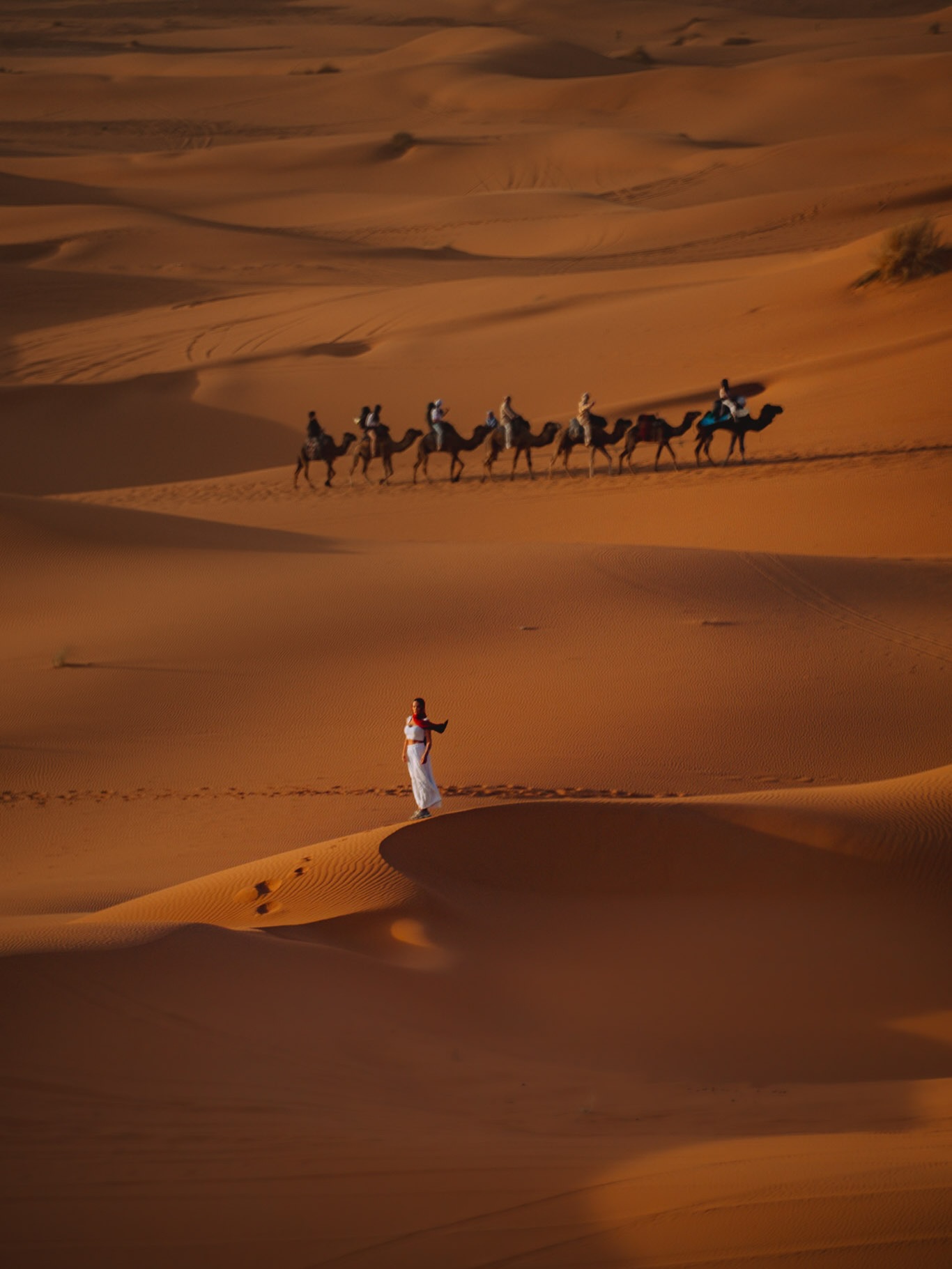
“The desert does not shout. It waits until you are quiet enough to hear it.” Berber proverb, southeastern Morocco
Where to Stay: Merzouga Desert Camps and Hotels
↑Merzouga and the surrounding hamlets of Hassilabied and Khamlia offer a genuinely wide range. These are the four main tiers:
Luxury Desert Camps
Furnished tents with private en-suite bathrooms, hot showers, and electricity. Meals prepared by a resident cook, plus evening gnawa music and fire performances. Prices typically include dinner, breakfast, and a camel ride.
Traditional Bivouacs
Shared facilities, simple canvas tents, and basic Berber meals cooked over a fire. The tradeoff for the lower cost is an experience that feels genuinely nomadic. Many travellers prefer this tier precisely for its simplicity.
Hotels and Riads
Dune-facing hotels in Merzouga village combine modern amenities such as a swimming pool, spa, and climate control with traditional Moroccan architecture. Ideal for anyone who wants comfortable nights without sleeping in a tent.
Local Guesthouses
Family-run maisons d’hôtes in Hassilabied offer the most genuine cultural exchange. Meals are home-cooked, rooms are simple, and conversations over tea can last for hours. The best value for money on the entire route.
Practical Tips: What the Guides Don’t Always Tell You
↑
Marrakech to Merzouga Tour: Frequently Asked Questions
↑How far is Merzouga from Marrakech?
The Marrakech to Merzouga distance is 556 km by road, crossing the High Atlas via the Tizi n’Tichka pass. Driving takes around 9 hours without stops, which is why most travellers spread the journey over two or three days.
How many days do I need for a Marrakech to Merzouga tour?
Three days is the standard and works well for most visitors. Two days is possible but heavy on driving. Four days, with a second night at Erg Chebbi, gives the most relaxed and rewarding experience of the desert.
Is the desert trip from Marrakech worth it?
Yes, provided you accept the driving involved. The route packs mountain passes, UNESCO kasbahs, oasis valleys, and the tallest dunes in Morocco into a single journey. Very few road trips anywhere offer this much variety in under 600 km.
What is the best month to visit the Erg Chebbi dunes?
April, May, September, and October offer the best combination of comfortable daytime temperatures, warm evenings, and golden dune light. Summer is hotter but excellent for stargazing and traditional sand therapy.
Can I do the Merzouga desert tour without a car?
Absolutely. The Supratours overnight bus (around 220 MAD) runs daily from Marrakech and arrives at sunrise, and Ryanair flies to nearby Errachidia three times a week. Once in Merzouga, camps and guesthouses arrange all activities locally.
Is a night in a Merzouga desert camp comfortable?
It depends on the tier you choose. Luxury camps offer real beds, private bathrooms, and hot showers, while traditional bivouacs are simpler but authentic. In winter, ask for extra blankets, since desert nights can approach freezing.
Plan Your Marrakech to Merzouga Tour
Speak directly with Jalila, our multilingual desert specialist, for a personalised itinerary, real-time pricing, and honest recommendations. No scripts, no upselling.
Chat with Jalila on WhatsApp